To check a used car’s suspension, steering and tyres, do four things: press down on each corner of the car and watch how it settles, listen for knocks and clunks over bumps, feel for play or pulling in the steering wheel, and inspect the tyres for uneven wear, cracks and age. You can do all of this in about 20 minutes without special tools. Because worn suspension is common on cars that have lived on rough roads, it deserves real attention before you pay.
Why Nigerian roads punish suspension
Suspension parts act like the legs and knees of your car. Every pothole, broken edge, unmarked speed bump and flooded section sends a shock through shock absorbers, springs, rubber bushings and joints. Over years, these parts wear out faster than they would on smooth roads.
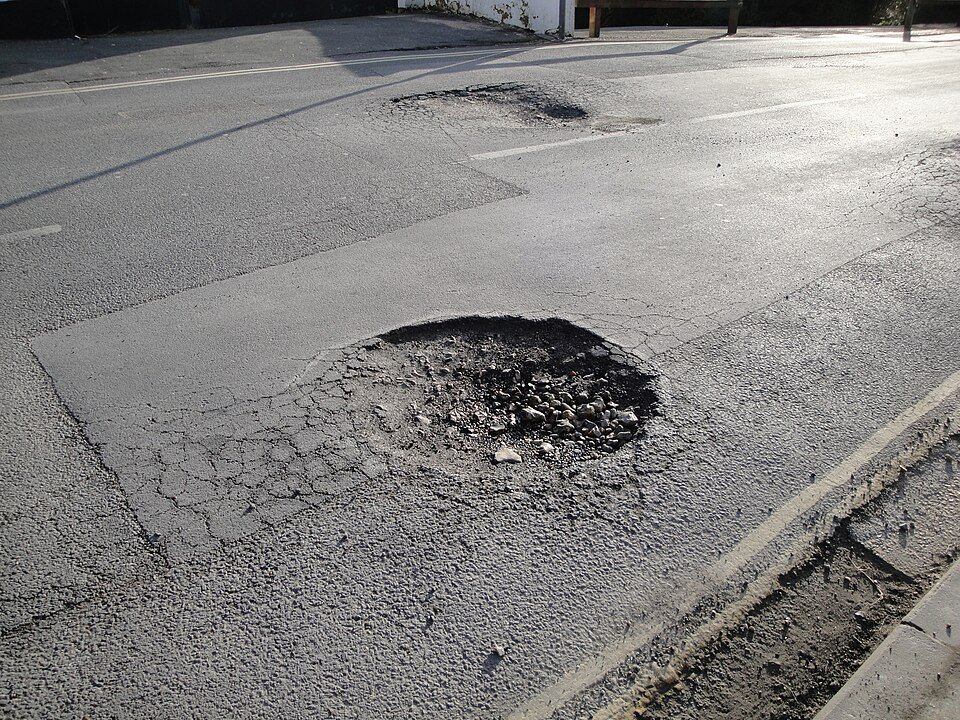
That is why a car with a clean body and a tidy interior can still drive badly. If you want to understand the kind of damage involved, read our guide on how roadside potholes damage your car.
Potholes like this one hit the wheels, shock absorbers and steering parts hard. Photo: Wikimedia Commons (see the file page for author and licence).
Start with the car parked
Look at how it stands
Park the car on flat ground and step back. Does one corner sit lower than the others? Is the car leaning to one side? A sagging corner often means a tired spring or a failing shock absorber. Also check that the gap between each tyre and the body looks roughly the same on both sides.
The bounce test
Push down hard on one front corner, near the wheel, then let go. A healthy car comes up once, maybe settles once more, and stops. If it keeps bouncing up and down like a boat, the shock absorber on that corner is likely weak. Repeat on all four corners and compare them. This is a rough test, not a lab result, but it is useful and costs nothing.
Look for leaks
Shine a torch at the shock absorbers behind each wheel. A little dust is normal. Oily, wet or dripping shocks have usually lost their fluid and no longer do their job. Also look at rubber boots around joints. Torn, split or missing boots let dirt in and wear parts quickly.
Ball joints and bushings in plain terms
A ball joint is a swivel that lets the wheel move up and down and turn left and right. A bushing is a rubber cushion that stops metal parts knocking against each other. When either wears out, you get looseness, noise and sloppy steering. You will not see this easily when parked, so the test drive matters. Still, look for cracked, squashed or oily rubber bushings and for any joint that looks loose or has grease leaking out.
Check the tyres carefully
Tyres tell you a lot about the car’s history. They also cost real money to replace, so use them in your negotiation.
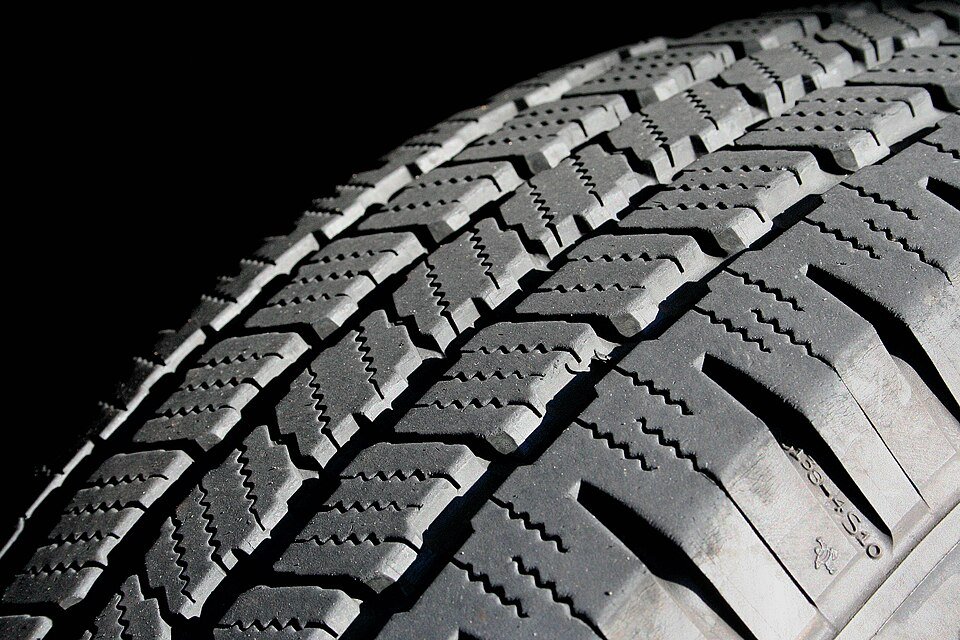
Look closely at the grooves across the whole width of the tyre, not just the middle. Photo: Wikimedia Commons (see the file page for author and licence).
Uneven wear: what it suggests
Worn on the inside or outside edge only: this often points to an alignment problem or worn suspension parts that let the wheel tilt.
Worn in the middle: the tyres may have been run over-inflated.
Worn on both edges: they may have been run under-inflated, or the car may have been carrying heavy loads.
Patchy, scalloped or choppy wear: this can suggest weak shock absorbers, because the tyre is bouncing as it rolls.
Different wear on the left and right tyres: ask why. It could be a bent part from a hard hit or an old accident.
These are clues, not proof. Wear patterns point you towards what to check next. They do not replace a proper inspection.
Tread depth
Look at the grooves across the whole width of each tyre. If the grooves are almost flat with the rubber, the tyre is near the end of its life. In the rainy season, thin tread makes braking on wet roads much worse. Check all four tyres and the spare.
Age and cracks
Rubber hardens with heat and time, even if the tyre barely moved. Look for tiny cracks in the sidewall and between the tread blocks, bulges, cuts, or exposed cords. A bulge means damage inside the tyre and is a reason to replace it. On the sidewall, you will find a four-digit code that shows the week and year of manufacture; the first two digits are the week and the last two are the year. A tyre that looks fine but is many years old may still be unsafe. For more on this, see our guide on when to replace car tyres in Nigeria.
Matching tyres and the spare
Four mismatched brands or sizes can be a sign the seller fitted the cheapest tyres just to sell. That is not always a problem, but ask. Also confirm the spare is inflated, and that the jack and wheel spanner are present.
Steering checks before you drive
With the engine on (if it has power steering), turn the wheel gently left and right. There should be very little free movement before the wheels respond. A lot of looseness can suggest worn steering parts. Turn the wheel fully to each side and listen for groaning, which can point to low power steering fluid or a weak pump. Also look under the bonnet for wet patches around the steering pump and hoses.
The test drive: what to do and what to feel
A short drive around a smooth estate road tells you very little. Plan a route that includes rough patches, a few speed bumps, a bend or two and a straight stretch where you can safely go at moderate speed. Ask the seller to stay quiet and switch off the radio and air conditioner for part of the drive so you can hear properly.
Noises to listen for
Knocking over small bumps: often linked to worn shock mounts, stabiliser links or ball joints.
A heavy clunk over a big bump: can suggest a worn joint, a failed bushing or a weak shock.
Creaking over speed bumps or when turning: usually dry or worn rubber and joints.
Clicking when turning sharply: may point to a worn drive joint.
Humming that changes with speed: can be a wheel bearing or uneven tyres.
Pulling and vibration
On a straight, flat stretch, hold the wheel lightly. If the car drifts to one side, the alignment may be off, or a tyre or brake may have a problem. Also notice whether the steering wheel returns to centre by itself after a turn. Vibration through the steering wheel at certain speeds can come from unbalanced wheels, bent rims or worn parts. Vibration only when braking often suggests warped brake discs.
Brake check on the drive
On a safe, clear road, brake firmly from moderate speed. The car should slow in a straight line. Be wary if it pulls to one side, if the pedal feels spongy, if you feel pulsing, or if you hear grinding or squealing. Brakes and suspension work together, so a car that dives forward badly under braking may have tired front shocks.
Alignment
Alignment means the wheels point the same way as the car. If the steering wheel sits crooked while the car goes straight, or the car pulls, or the tyres wear on one edge, alignment is likely off. Alignment can be adjusted, but if worn parts are the cause, adjusting it alone will not hold.
What to ask the seller
When were the shock absorbers, tyres and brakes last changed, and do you have receipts?
Has the car had any accident or hard hit to a wheel?
Will you allow a mechanic of my choice to check it?
An honest seller will answer calmly. Be careful if the answers keep changing or you are rushed.
Rough repair priorities
You do not need to know prices to decide what matters most. Think in this order:
Safety first: brakes, steering looseness, damaged or bulging tyres. These should be fixed before you drive the car regularly.
Parts that cause more damage if ignored: leaking shocks, worn ball joints and torn boots, because they also wear tyres and other parts.
Comfort and small fixes: minor creaks, light rubber wear and cosmetic issues.
Ask a trusted mechanic to give a written list of what needs work now and what can wait, then use it to negotiate. Our used car inspection guide covers the rest of the car, so you can combine everything into one decision.
When to walk away
The car pulls hard to one side and the seller has no explanation.
You feel major looseness in the steering.
Tyres show bulges or exposed cords, or wear is badly uneven on one side.
The frame or suspension mounts look bent, freshly welded or repainted in a way that hides damage.
The seller refuses an independent inspection or test drive on rough roads.
You find several problems at once. A pile of small faults often means a neglected car.
There will always be another car. Walking away is cheaper than inheriting someone else’s problems.
Frequently asked questions
Can I check suspension without a mechanic?
Yes, you can do the first round yourself: the bounce test, a visual check for leaks and torn rubber, the tyre inspection, and a test drive on rough roads. If the car passes and you still want to buy it, pay a mechanic for a proper check on a lift. A professional can see worn parts you cannot.
Is a noisy suspension always a reason to reject the car?
Not always. Some noises come from cheap, dry bushings or loose small parts. But you should treat any knock or clunk as a question that needs an answer before you pay. Have a mechanic identify the cause, and use the repair as a bargaining point or walk away if it points to several worn parts.
How can I tell if the tyres are too old even though the tread looks good?
Check the date code on the sidewall and look for cracks, hardening or bulges. Rubber ages with heat and sunlight, so a tyre with plenty of tread can still be risky. If you cannot read the code or you are unsure, treat the tyres as something you will need to replace and reflect that in your offer.
Conclusion
Suspension, steering and tyres decide how safely and comfortably a car handles Nigerian roads. Do the bounce test, look for leaks, read the tyre wear, and drive the car over rough ground while listening closely. Ask the seller honest questions, rank any repairs by safety, and be ready to walk away. For general safety information on vehicles, you can also visit NHTSA. A patient check today can save you from an expensive surprise later.
A hybrid car battery can last many years, but age, heat, use and care all matter. Learn the warning signs and how to check a used hybrid before you buy in Nigeria.
Thinking of buying a used RAV4? Here are the Toyota RAV4 problems often reported, what to inspect, how to test drive, and when to walk away in Nigeria.
Vehiclespot.ng is a leading car dealer in Nigeria, offering an innovative online automobile marketplace that connects buyers and sellers effortlessly. In addition to buying and selling vehicles, we provide a range of auto services designed to meet all your automotive needs.